This past week my crew went somewhere I never expected to have a project: Arizona. I'm not sure if other crews have gone there in the past, but it seemed quite unusual to me because I didn't think we would ever leave the state for any of our projects. The reason we did was because we were working with Lake Mead National Recreation Area, which is located in both states, and it just so happened that the work they needed us for was over the border. I wasn't complaining, though, because it meant that we got to see another amazing place that I never expected to see. The scenery where we were working was breathtaking because we were right where Lake Mead NRA meets Grand Canyon National Park. The work we were doing was road decommissioning and installing barriers to keep people from off-roading in the areas we were closing off; and for the entire week, anytime we were working, we could just glance up and see the mouth of the Grand Canyon where the river flows out of the Canyon and meets up with Lake Mead. You can't ask for a better view than that while you're at work. It's things like that that are constantly reminding me how lucky I am to have a job that allows me to be outside so much, seeing new places and having new experiences.
One part of the experience, recently, that has not made me feel quite as lucky is the cold weather. It did get colder much more gradually in Vegas than I am used to from New England but usually it is slightly colder than Vegas in the areas where we work, and this week was no exception. I don't know exactly how cold it got during the nights but it was definitely below freezing (which was quite apparent when the milk in my cereal began freezing to the side of the bowl while I was eating breakfast). Sleeping in weather that cold can be quite uncomfortable, so when we have those cold temperatures during a project I've taken to sleeping with all of my layers on, including hat and scarf, and using my sleeping bag liner inside my sleeping bag to add more warmth (this past week Corey lent me his liner also so I had 2 liners in addition to my sleeping bag), then pulling my sleeping bag over my face to keep it warm. My feet also get very cold during the night so my strategy for that is to put hot water in my metal water bottles before bed and stick them in the bottom of my sleeping bag to warm up my feet. Unfortunately the heat usually dissipates completely by around 3:00 am, but for those first few hours my feet stay wonderfully warm. The morning also presents several challenges of it's own, other than frozen milk. Since we have to wake up before dawn, it hasn't started to get warm yet, so getting out of the sleeping bag can be a challenge, although sleeping in our Carhartt work pants instead of changing into more comfortable pajamas makes it slightly easier because you don't have to undress or put on freezing cold pants in the morning. The boots are a different story though. There is no good way to keep boots warm during the night, even if they are inside the tent, so putting my boots on in the morning can feel like putting my already-cold feet into ice boxes. Then, breakfast involves trying to eat as quickly as possible so I don't have to expose my hands to the cold for too long; and then on the last morning of the week, when we have to pack up our tents, it can be a difficult choice between trying to finish taking the tent down without gloves on before your hands are completely frozen, or fumbling with the buckles and clasps wearing gloves and possibly taking twice as long. On these cold mornings it can be a blessing when the worksite is far enough away to require driving because then we can put the heat on in the truck to warm up. As much as this might sound like a terrible situation to deal with, and sometimes it feels pretty terrible, it's worth it because it's all part of the experience. If there were no challenges the job would not be as rewarding, and by the end of this year I will feel very accomplished being able to say that I lived in a tent most of the year in all types of weather.

Tuesday, December 31, 2013

Monday, November 11, 2013
Getting Oriented
And so it begins, another year in the NCC. On one hand I’m
extremely excited – why else would I have stayed on as a leader – on the other,
I’m terribly nervous. A year in the program has taught me that not every day is
a walk in the park. Already we face challenges.
Orientation lands smack dab in the
middle of monsoon season in the Mojave. Camp Foxtail, nestled away in the
upper reaches of Lee Canyon, is at the
epicenter of southern Nevada’s “Thunderstorm Alley.” The Spring Mountains
present a massive barrier to warm, moist air rolling in from the West. The
rugged range wrings all the moisture from the air, leading to torrential
downpours and flash floods; like the one we were trapped by this week.
After two and a half days of
classroom instruction we're ready to hike out to Rocky Gorge and get some
tools in the ground. We arrive on a gray, drizzly morning; everyone groaning
in protest as we explain the scope of our day’s work. As we practice our
trail-building techniques the rain only grows heavier. Soon a barrage of thunder
and lightning shuts us down. Swinging large metal tools on a treeless ridge is
asking to get struck. So, we must sit and wait for the danger to pass, cold and
miserable in the chilling rain.
Finally, the rain stops. The
leadership gathers around and begins discussing options when suddenly I hear
what can only be the sound of rushing water. We all turn to look at the wash
below us. There it is, a 6 foot wide, 3 foot deep river. Frothing and churning
where only seconds ago was nothing but damp sand and gravel. A mile away – on
the other side of the flood – are our trucks. Now what? The water looks unsafe
to cross, but further up the canyon we can see the rain coming down hard
again. It’s decided, we move now. Otherwise we risk ending up more stranded
than we already are.
“Everyone grab your tools and move
now! Stay together and watch out for more flooding and lightning!”
Thirty minutes later and we’re all
safely in our trucks again. We've only had a couple of hours of practice on the
trail, but mother nature has the upper hand. We end our orientation with less
experience, but more memories, than we had planned on. This is not the first
time, nor will it be the last, that I've been stuck in a sticky situation. This
year comes with greater responsibility; I have the safety and well-being of
four others to look out for. But, I've always loved a challenge, so bring it
on!
-Nick Brasier
Monday, October 21, 2013
Chainsaw Training and Trail Building with the NCC
 |
| Nighttime fun at the campground |
The morning started as usual, with our safety circle (because it was our first day with the chainsaw it was longer than usual), and a stretch to get our muscles moving and blood pumping. In the safety circle we discussed all the hazards related to the chainsaw and felling trees, as well as how to mitigate those hazards. That first day, we learned the ins and outs of the saw with regard to maintenance and cleaning, as well as chain sharpening. It was cold, and the 5 of us were huddled around the saw, taking it apart and learning troubleshooting from our Crew Supervisor, KV. Once we were versed on maintenance, troubleshooting, safety and felling techniques we were ready to operate the saw.
 |
| Chainsaw safety and operation |
 |
| Limbing and bucking practice |
Our crew was designated to work on a reroute section in Mack's Canyon. Reroutes are done for a number of reasons such as increasing/decreasing the length of the trail, or creating better tread (walking surface) that is less steep and more sustainable (which allows for the trail to exist without having a large impact on the environment). The hike into the reroute was just under 2 miles, a nice warm-up for the long workday.
 |
| Return to trail work |
 |
| Trail reroute in Mack's Canyon - before and after |
Wednesday, October 16, 2013
Flash Flooding in Great Basin Nat'l Park
My first 8-day project was at Great Basin National Park, which is about 6 hours north of Vegas and right on the border with Utah. The first day consisted of driving there and working for a few hours, clearing some trees from the sides of the road up to our campsite, then going and setting up camp. Our campsite was about 30 minutes from the main road, up a dirt road into the mountains. The whole drive up the road, and the whole way to the park initially, I was just staring out the window at all the beautiful mountain scenery. Everywhere I go around here is so different than anything I'm used to on the east coast, and I find myself constantly mesmerized by the beauty of the mountains and the cool colors of the rock. At first it was almost like being on another planet. I'm getting more used to it now, but I still think it's amazing to look at.
Day 2 turned into quite an adventure. In the morning we had to drive about an hour to get to the site where we were working, then we had to hike about 2 miles carrying our tools. Then we worked for about 4 hours maintaining a trail that was starting to get overgrown, then we hiked back the 2 miles to the trucks, leaving our tools cached at the work site so we could come back to them the next day. As we got back to the trucks it started to rain, so we tried to get out as quickly as we could. While we were driving down the dirt road, we started to see water flowing over the road from the hill on one side, which was worrying because of the potential for a flash flood. We thought we were doing good and were going to beat the water down the mountain until we came around a corner and saw tons of water coming down the mountain from the road that was about to intersect with ours. We stopped to assess the situation and it turned out that the huge flash flood, although not a danger to us where we were parked, came dangerously close to the road a little bit farther down, so we couldn't drive past it. We radioed to the park rangers to see if they could come pick us up, and it turned out that the flood had washed out a part of the road farther down so the rangers couldn't get all the way to where we were. The only solution was to leave the trucks where they were and hike down the road to where the rangers could pick us up. By that time the flood had calmed down a little but had not died down completely, so it wasn't dangerous to walk but debris had been pushed onto the road by the water so we couldn't drive to where the rangers were; walking was the only option. We made it to the rangers without any incident, found a safe place to jump across the water, and they drove us back to our campsite.
Then the next day was a little of a logistical nightmare because we had no trucks and still had tools stuck at the work site. The plan we came up with was for the project partner to shuttle us by crew back to the trucks and then we'd go back to the work site to get the tools. But since the trucks were about an hour away from our campsite the shuttling process took hours, the first few of which my crew spent waiting at our campsite for the project partner to come back for us. Once we got back to the trucks we only really had time to make the hike to the campsite, get the tools, and then leave again, so that's pretty much the only thing my crew accomplished for the whole 10-hour work day. Those two days reinforced yet again how much plans can change in this type of work.
Day 4 was back to actually getting projects done. We didn't go back to the original work site for obvious reasons, so we moved on to the next project. This one involved hiking 4.5 miles from our campsite over a mountain and into the valley on the other side. The hike was really steep on the way up and the way down, and it took us over 2 hours of the hardest hiking I'd ever done to actually get to where we were working. Once we got there, we worked on removing downed trees that were blocking a path so that more work could be done on the trail later on. Then we had to hike the same 4.5 miles back over the mountain. So after hiking 9 miles, we were all pretty tired at the end of the day.
Day 5 we hiked the same hike again, but this time it took less time. I think we all went faster just so we could get it over with sooner. The work was pretty much the same, but it rained for parts of the day so we were all slightly less enthusiastic because of that. Rain is never very motivating when you have to be outside all day. Day 6 we hiked the same mountain for a third time, and this time was by far the hardest because I was so tired from the other 2 days of the same hike. By that point in the week we had hiked almost 40 miles altogether, so I was really struggling. On the way back up the mountain in the afternoon I felt like I had to stop every 2 minutes to catch my breath. I had learned in the past few days that I was one of the slowest hikers in the group on the steep uphill sections, and that last day was even worse than usual. But eventually I made it, and was really happy that it was the last time I had to do that hike.
The last 2 days we did more of what we'd done the first day - clearing trees from the sides of the road. The last day we only did about an hour of work because we had to drive back to Vegas and then do about 2 hours of "de-rig" once we got there. It was a long, tiring, but good week, and the 5 days off afterwards were great. There were challenges and ups and downs, but all-in-all it was a great start to the year at the NCC.
Day 2 turned into quite an adventure. In the morning we had to drive about an hour to get to the site where we were working, then we had to hike about 2 miles carrying our tools. Then we worked for about 4 hours maintaining a trail that was starting to get overgrown, then we hiked back the 2 miles to the trucks, leaving our tools cached at the work site so we could come back to them the next day. As we got back to the trucks it started to rain, so we tried to get out as quickly as we could. While we were driving down the dirt road, we started to see water flowing over the road from the hill on one side, which was worrying because of the potential for a flash flood. We thought we were doing good and were going to beat the water down the mountain until we came around a corner and saw tons of water coming down the mountain from the road that was about to intersect with ours. We stopped to assess the situation and it turned out that the huge flash flood, although not a danger to us where we were parked, came dangerously close to the road a little bit farther down, so we couldn't drive past it. We radioed to the park rangers to see if they could come pick us up, and it turned out that the flood had washed out a part of the road farther down so the rangers couldn't get all the way to where we were. The only solution was to leave the trucks where they were and hike down the road to where the rangers could pick us up. By that time the flood had calmed down a little but had not died down completely, so it wasn't dangerous to walk but debris had been pushed onto the road by the water so we couldn't drive to where the rangers were; walking was the only option. We made it to the rangers without any incident, found a safe place to jump across the water, and they drove us back to our campsite.
Then the next day was a little of a logistical nightmare because we had no trucks and still had tools stuck at the work site. The plan we came up with was for the project partner to shuttle us by crew back to the trucks and then we'd go back to the work site to get the tools. But since the trucks were about an hour away from our campsite the shuttling process took hours, the first few of which my crew spent waiting at our campsite for the project partner to come back for us. Once we got back to the trucks we only really had time to make the hike to the campsite, get the tools, and then leave again, so that's pretty much the only thing my crew accomplished for the whole 10-hour work day. Those two days reinforced yet again how much plans can change in this type of work.
Day 4 was back to actually getting projects done. We didn't go back to the original work site for obvious reasons, so we moved on to the next project. This one involved hiking 4.5 miles from our campsite over a mountain and into the valley on the other side. The hike was really steep on the way up and the way down, and it took us over 2 hours of the hardest hiking I'd ever done to actually get to where we were working. Once we got there, we worked on removing downed trees that were blocking a path so that more work could be done on the trail later on. Then we had to hike the same 4.5 miles back over the mountain. So after hiking 9 miles, we were all pretty tired at the end of the day.
Day 5 we hiked the same hike again, but this time it took less time. I think we all went faster just so we could get it over with sooner. The work was pretty much the same, but it rained for parts of the day so we were all slightly less enthusiastic because of that. Rain is never very motivating when you have to be outside all day. Day 6 we hiked the same mountain for a third time, and this time was by far the hardest because I was so tired from the other 2 days of the same hike. By that point in the week we had hiked almost 40 miles altogether, so I was really struggling. On the way back up the mountain in the afternoon I felt like I had to stop every 2 minutes to catch my breath. I had learned in the past few days that I was one of the slowest hikers in the group on the steep uphill sections, and that last day was even worse than usual. But eventually I made it, and was really happy that it was the last time I had to do that hike.
The last 2 days we did more of what we'd done the first day - clearing trees from the sides of the road. The last day we only did about an hour of work because we had to drive back to Vegas and then do about 2 hours of "de-rig" once we got there. It was a long, tiring, but good week, and the 5 days off afterwards were great. There were challenges and ups and downs, but all-in-all it was a great start to the year at the NCC.
Thursday, October 3, 2013
Pearls of Pahranagat
With endangered birds in the balance,
Cat-tails with claws
And cows on reconnaissance,
The marsh in the midst
Gave us reason for pause.
From whence the fence
could no longer dispense
any defense
of any culpable consequence,
We do not know.
But hence,
no expense was spared.
Each NCC crew member pared.
To set the stage
For a full fence repair.
Not a feather to be lost.
Nor a breast to be sauced.
We readied our cat-tail salads
To be tossed.
With brush cutters and weed eaters in our paws,
Each cat-tail and bull rush reminisced us of our in laws.
And when the cutting came too condensed.
We each looked over our shoulder
To see whom among us was the most dense.
Kaitlin cut claw to claw.
While Lizzy laid down the law.
And Alison left the ranchers in awe.
Nate's bush was seen as far as Utah.
But Paul's pitch fork took the cake.
While I was left with only a mooo and an ache.
"The Valley of Shinning Water"
Has a special place in our hearts.
Water in craft.
And shimmering in art.
Sung
Cat-tails with claws
And cows on reconnaissance,
The marsh in the midst
Gave us reason for pause.
From whence the fence
could no longer dispense
any defense
of any culpable consequence,
We do not know.
But hence,
no expense was spared.
Each NCC crew member pared.
To set the stage
For a full fence repair.
Not a feather to be lost.
Nor a breast to be sauced.
We readied our cat-tail salads
To be tossed.
With brush cutters and weed eaters in our paws,
Each cat-tail and bull rush reminisced us of our in laws.
And when the cutting came too condensed.
We each looked over our shoulder
To see whom among us was the most dense.
Kaitlin cut claw to claw.
While Lizzy laid down the law.
And Alison left the ranchers in awe.
Nate's bush was seen as far as Utah.
But Paul's pitch fork took the cake.
While I was left with only a mooo and an ache.
"The Valley of Shinning Water"
Has a special place in our hearts.
Water in craft.
And shimmering in art.
Sung
Tuesday, September 3, 2013
NCC 2013-2014 Supervisors!
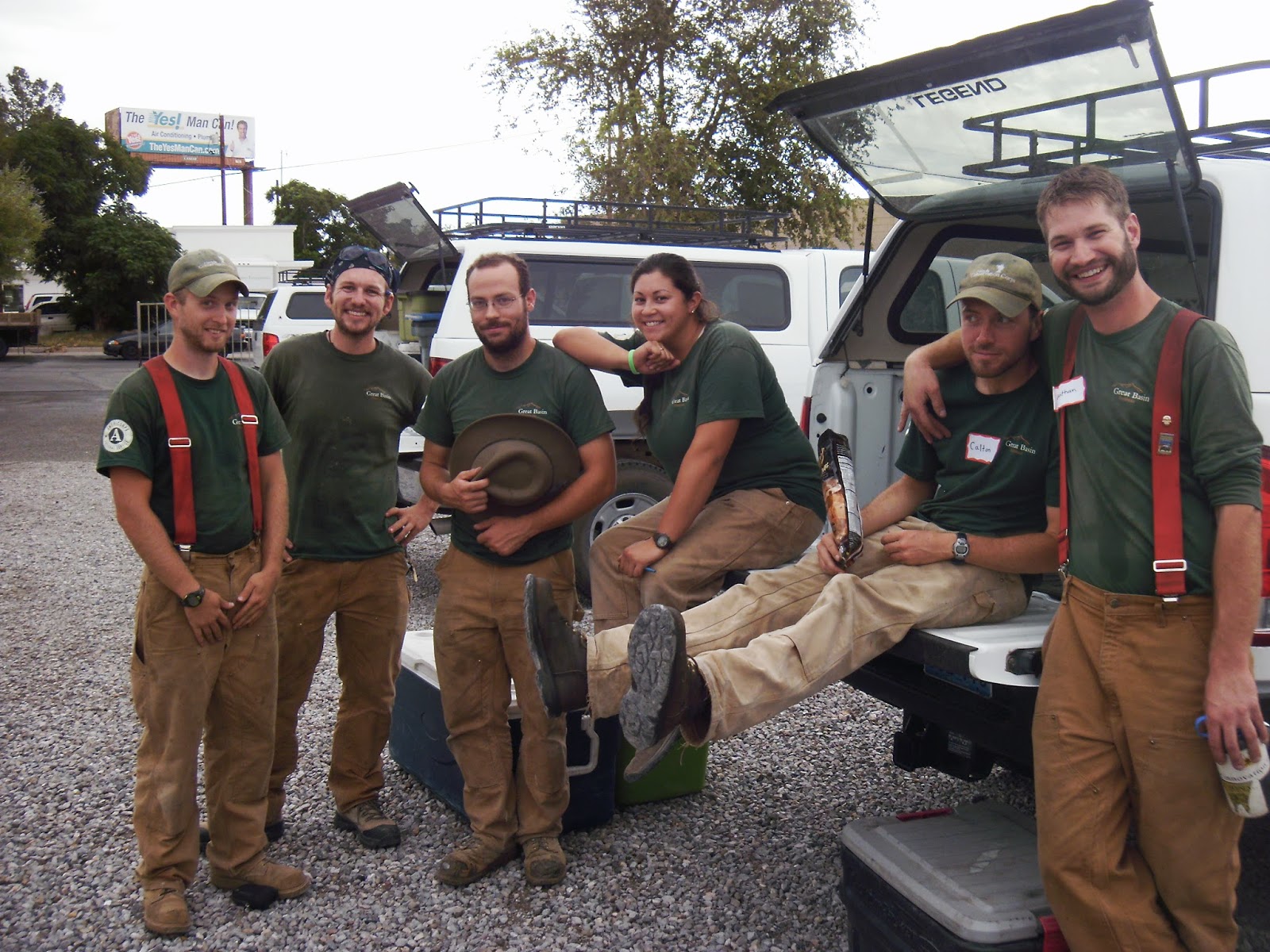
This season the NCC welcomes 6 new staff supervisors to the Las Vegas field office! Corey, Nick, Nathan, KV, Cal, and Nate all started as AmeriCorps members in the NCC within the last 2 years...whether they spent summers in Great Basin National Park, the Spring Mountains, or were part of our year-long program, these folks know their stuff when it comes to the NCC!
All six started working together when they were accepted into the NCC's Leadership Development Training (Crew Leader Training) this past spring. After the 13-week training program these folks, along with five others, earned their place as summer Crew Leaders. Each had the opportunity to run a five-person crew for three months, digging tread and cutting trees out of our Reno and Ely field offices. Putting their leadership and technical skills to the test, they showed that they have what it takes to successfully lead our crews in the field!!
They are already off to a great start this season, and we could not be more proud of the level of communication, initiative and positivity that they are bringing to the table. We're looking forward to a great season, and are excited to watch these six facilitate awesome corps experiences for their members. It's going to be a stellar year!
Tuesday, August 13, 2013
The End of the Road
Our time here draws to a close. Some of us are counting the days,
content to hurry on to the next exciting chapter of their lives. Others
try to not think of the dwindling days. Each days that manages to slink
by means one less day in this western wonderland. One less majestic
sunrise greeting us on the short drive to the work site. One less placid
mountain sunset to see our tired bodies off to bed.
It seemed like only yesterday we were in Winnemucca. Wide-eyed and unsure. Back when the tools used to feel heavy and the worked used to feel difficult. But here were are, a mere two months later. We have cut a lot of tread and driven a lot of miles together. We have grown both more competent and stronger; gently hardened over time by the resplendent Nevadan wilderness.
I used to associate Nevada with words like "barren" "lonely" "desolate" and "arid". But after my time here I have found the Nevadan wilderness is a place of stoic grace and life and growth can be found here if you happen to know where to look.
I will never forget this experience. I will not forget what I have seen, what I have helped accomplish, the people I have met, the hardships endured, and the bonds I have forged.
It seemed like only yesterday we were in Winnemucca. Wide-eyed and unsure. Back when the tools used to feel heavy and the worked used to feel difficult. But here were are, a mere two months later. We have cut a lot of tread and driven a lot of miles together. We have grown both more competent and stronger; gently hardened over time by the resplendent Nevadan wilderness.
I used to associate Nevada with words like "barren" "lonely" "desolate" and "arid". But after my time here I have found the Nevadan wilderness is a place of stoic grace and life and growth can be found here if you happen to know where to look.
I will never forget this experience. I will not forget what I have seen, what I have helped accomplish, the people I have met, the hardships endured, and the bonds I have forged.
Subscribe to:
Posts (Atom)